On July 1, 2026, Plex raised the price of its lifetime pass to $749.99. In early 2025, that same pass cost $119.99. Add the 2025 change that moved remote streaming behind a paywall, and it’s no surprise that so many people are looking for a Plex alternative right now.
I want to be clear up front: Plex is still good software, and I’ve had a great experience running it for years. But the math around it has changed, and the alternatives are better than they’ve ever been. This list is short on purpose. Rather than rattling off ten names, I’m covering the three options I’d actually consider, what each one costs in 2026, and which one I’d switch to.
The Quick Answer
For most people leaving Plex in 2026, Jellyfin is the answer. It’s completely free, open source, and includes hardware transcoding at no cost, which is the exact feature Plex locks behind the Plex Pass. Emby is the closest thing to Plex’s polish, and its $119 lifetime license is what Plex’s lifetime pass cost in early 2025. Kodi is a different kind of tool entirely, and I’ll explain where it fits below.
If you landed here from the other direction and want a Jellyfin or Emby alternative, the same three apps trade places. Jellyfin’s closest relative is Emby (Jellyfin was forked from it), and Plex is still the most polished option if you can live with the pricing. The comparisons below work whichever one you’re leaving.
Why People Are Leaving Plex in 2026
The short version: Plex has raised prices twice in about 15 months. In April 2025, Plex announced major changes: the lifetime Plex Pass went from $119.99 to $249.99, monthly and annual subscriptions went up alongside it, and remote streaming, previously free, became a paid feature.
2026 brought round two. On June 1, the introductory pricing for the Remote Watch Pass ended, putting it at $2.99/month or $29.99/year for anyone streaming from a server whose owner doesn’t have a Plex Pass. Then on July 1, the lifetime Plex Pass jumped from $249.99 to $749.99, with a new 5-year pass taking over the old $249.99 price. To be fair on the details: existing lifetime holders keep everything, streaming inside your own home is still free, and if the server owner has a Plex Pass, everyone they share with can stream remotely at no cost.
None of this makes Plex bad software. It makes Plex expensive software, and the pattern is the bigger problem: two major increases in a little over a year makes it hard to trust what the price will be in 2028. That uncertainty, more than any single number, is why the options below deserve a serious look.
Jellyfin: The One I’d Switch To
Jellyfin is a free, open-source media server that started as a fork of Emby back in 2018. It does the same core job as Plex: you install the server on the device that stores your media, install client apps on your TV, phone, or computer, and stream. The difference is that everything in Jellyfin is free, including hardware transcoding, Live TV, and DVR, all features the other two charge for.
In my experience, Jellyfin runs best on Docker, which effectively gives it support on any platform that matters, and the list of native server packages keeps growing. I like running it on a NAS, since that’s usually where the media already lives, and I have full setup guides for a Synology NAS and even a Raspberry Pi.
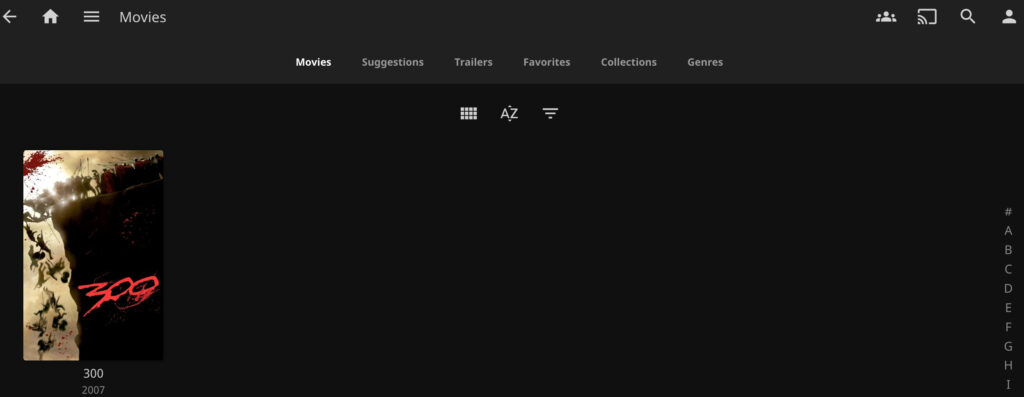
Development is also moving faster than it ever has. Jellyfin shipped a steady stream of releases through 2025 and 2026, and the client apps, which used to be its weak point, have improved a lot. A polish gap between Jellyfin and Plex still exists, but it keeps closing, and Jellyfin’s interface has one advantage no update can give Plex: it shows your content and nothing else.
The one real weak spot is remote access. Plex handles remote streaming for you (that’s part of what you’re paying for), while Jellyfin leaves the setup to you. It’s free and very doable, and I wrote a full guide on how to access Jellyfin remotely covering the approaches I’d actually use.
Emby: The Closest Thing to Plex
Emby is the middle ground on this list, and it’s the option people leaving Plex tend to overlook. It uses the same server and client model, the interface is polished, and its native package support is excellent. Most NAS operating systems have an Emby Server package available, which matters if you’d rather avoid Docker entirely.
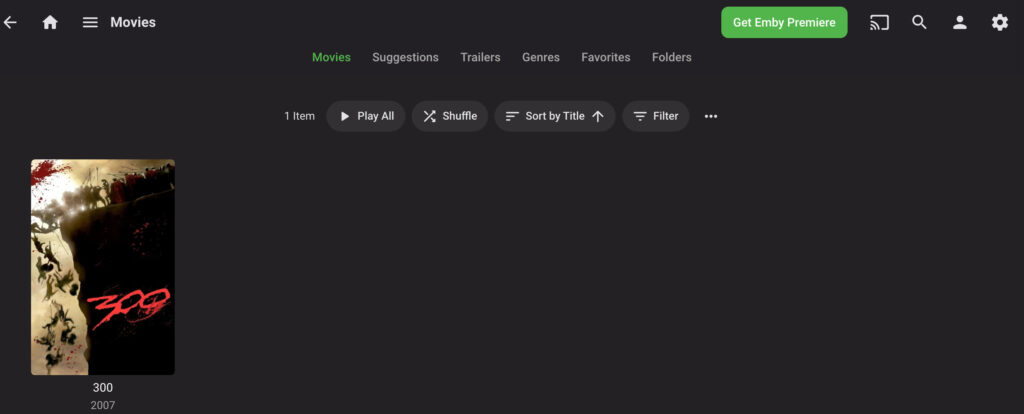
The core of Emby is free, but the features most people want sit behind Emby Premiere: hardware transcoding, offline downloads for phones and tablets, and DVR. Premiere runs $4.99/month, $54/year, or $119 for a lifetime license. That’s not free, but for context, $119 is what Plex’s lifetime pass cost in early 2025, and it’s less than one sixth of what Plex charges for lifetime access today.
The honest caveat is that Emby is closed source. It actually started as an open-source project, and when it went proprietary in 2018, Jellyfin forked from it. If open source matters to you, that settles the choice. If it doesn’t, Emby is a genuinely great media server: it’s reliable, the apps are solid, and it just works. I have a guide on setting up Emby on a Synology NAS if you want to try it.
Kodi: Not a Server, and That Matters
Kodi shows up on every Plex alternatives list, including this one, but it’s a different kind of application. Kodi has no server. It’s a media player that you install and configure on each device individually. Point it at your media, whether that’s local storage or an NFS share on a NAS, and it plays it with more format support and playback control than almost anything else. It’s available on almost every device, entirely free, and open source.
Where Kodi shines is customization: skins, community add-ons, even game emulation. The project is also very much alive, with Kodi 21 as the current stable release and Kodi 22 in beta as I write this.
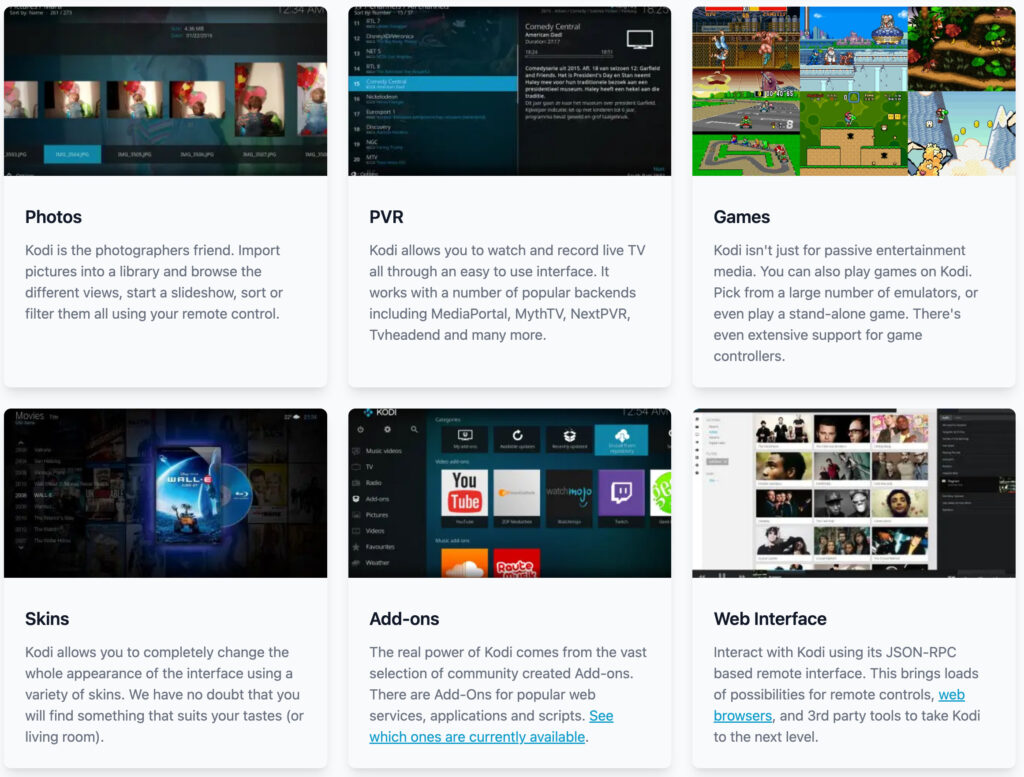
The problem is scale. Configure one living room TV and Kodi is great. Configure five devices and try to keep watch progress in sync between them, and it becomes a chore. That’s why my recommendation for Kodi in 2026 is to use it with a server rather than instead of one: the Jellyfin for Kodi add-on connects Kodi to a Jellyfin server, so you get Jellyfin’s central library and watch state with Kodi’s playback engine and skins on top.
Plex vs Jellyfin vs Emby: How They Compare
Here’s how the three server platforms stack up in 2026. Kodi sits this table out because it isn’t a server, and comparing it row by row would be misleading.
| Category | Jellyfin | Emby | Plex |
| Price | Free, everything included | Free core; Premiere at $4.99/mo, $54/yr, or $119 lifetime | Free tier; Plex Pass needed for key features, lifetime now $749.99 |
| Open Source | Yes | No (closed since 2018) | No |
| Hardware Transcoding | Free | Requires Premiere | Requires Plex Pass |
| Remote Streaming | Free, but you set it up yourself | Free, some setup required | Automatic; server owner needs a Plex Pass, or each viewer pays $2.99/mo |
| Server Platforms | Docker first; native packages growing | Native packages for most NAS operating systems | The widest native support |
| Best For | Most people switching in 2026 | Plex-style polish without Plex pricing | Zero-effort remote streaming |
The Hardware Side: What Runs These Well
Disclosure: Some links below are affiliate links, which means that I earn a percentage of each sale at no cost to you. Thank you for your support.
All three servers (and Kodi, for that matter) run on almost anything: a NAS, a mini PC, an old desktop. The spec that matters is hardware transcoding, which converts video on the fly when a TV or phone can’t play the original file directly. For that, you want an Intel CPU with Quick Sync. With Jellyfin the feature is free, with Emby it needs Premiere, and the hardware is the same either way.
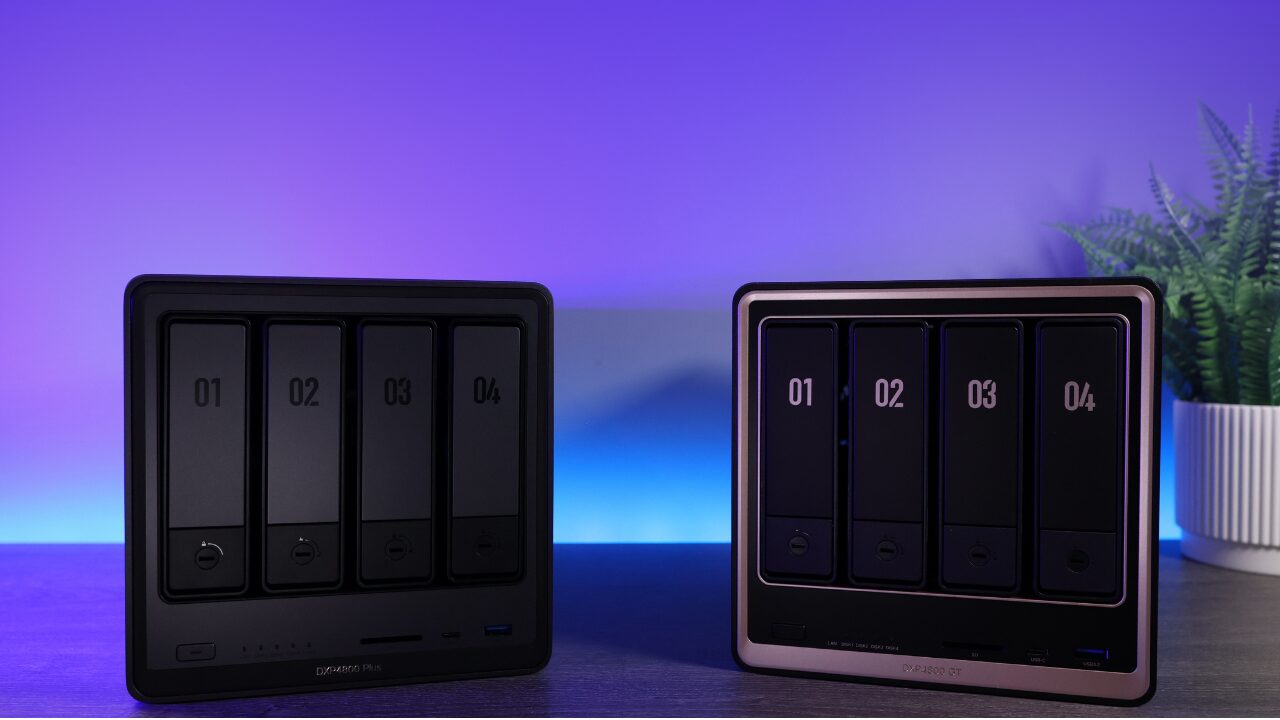
If you’re buying a box for this job, the UGREEN DXP4800 Plus is what I’d get: a 4-bay NAS with a Quick Sync CPU and 10GbE networking that handles multiple transcodes without issue. It’s the top pick in my best NAS for Plex roundup, and everything in that article applies to Jellyfin and Emby just the same. On a tighter budget, the 2-bay UGREEN DXP2800 gets you the same Intel Quick Sync transcoding for a lot less. And if you’d rather keep your storage where it is and run the server on a small dedicated box, an Intel mini PC like the Beelink EQ14 runs any of these servers in Docker easily.
If you already own hardware, try it there first, because every server on this list costs nothing to install. One caveat if you’re NAS shopping: several current Synology models, including the DS925+, use AMD CPUs with no iGPU, which means no hardware transcoding on any platform. That’s one of the main reasons I lean Intel for media boxes.
Which One I’d Switch To
Jellyfin, and you don’t have to commit to find out if you agree. Jellyfin runs right alongside Plex on the same machine, pointed at the same media folders. Set it up, use it for two weeks, and see if you miss anything. The trial costs nothing but an afternoon, which is exactly what a $749.99 lifetime pass is not.
If the polish gap bothers you, or you want native NAS packages without touching Docker, Emby at $119 lifetime is a fair deal in a way that Plex’s current pricing isn’t. And if you want the deeper head-to-head before deciding, my full Jellyfin vs Plex comparison stays updated with the latest pricing and my current verdict.
Last updated: July 2026. Pricing for Plex, Emby Premiere, and the rest reflects what each project has published as of this update; check their pricing pages for current numbers before buying anything.